
SHOCKS TO MACROECONOMIC FACTORS
CONTRIBUTORS

Tom Fisher
Head of U.S. Institutional

Pierre Caramazza
Head of Financial Institutions
The investment experts at Franklin Templeton spend a lot of time speaking to chief investment officers about “What if . . .” That is, the most beneficial discussions come from exploring the implications of what might happen—not guessing the future—and being prepared for those risks. To date, we’ve delved into some of the implications shocks to global growth, interest rates, inflation, regulation, geopolitics and demographics can have on portfolios.
To add to our thinking on shocks, we are now conducting semi-annual surveys of institutional investors to extend the dialogue and complement our conversations about “What if. . .” Here, we dig into the findings of our latest survey, which explores asset allocation, concerns about shocks and drills specifically into equity allocation.
We asked Tom Fisher and Pierre Caramazza, Head of U.S. Institutional and Head of Financial Institutions at Franklin Templeton, respectively, to interpret the highlights of the survey findings and where they lead us for future surveys, including: “alternatives differentiate” and “rose-colored glasses on shocks”.
If you would like to be involved in the next survey and join the conversation, email us at [email protected]
Tom Fisher: It is fair to say there were more than a few revealing surprises in the responses to the survey, including a perhaps over-optimistic view of how major shocks would affect respondents’ portfolios. Also, that we have a blind spot when it comes to alternatives. We need to dig deeper on that in our next survey.
Pierre Caramazza: It was curious to me how consistent the responses were from the 150 investment decision makers from North America.1 The group was a mix of chief investment officers (CIOs), investment officers, portfolio managers, directors of research, and research analysts—from asset owners and managers. Whether by asset size or investor type, we generally had very tight bands, not a lot of variance, among the responses. So, we will focus on the averages and dig into the findings.
Fisher: Let’s not cover everything in painful detail, but rather cover what we found to be most curious.…
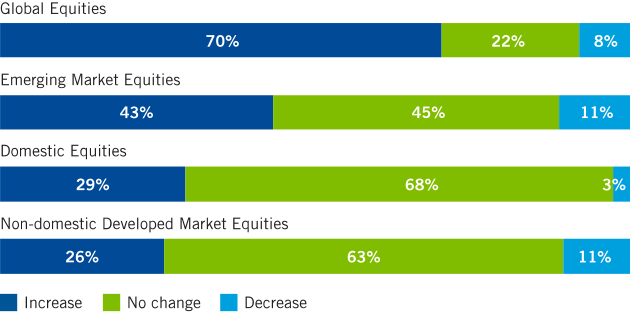
Caramazza: Good idea. I want to first jump to question 7. “Do you have plans to alter your equity holdings over the next six months
Look at the “decrease” percentages. All are 11% or less. Now this data was collected in May 2019, but still the bullish nature of these results surprises me. Maybe the Fed played a role. Anyway, it will be interesting to track this over time.
Fisher: To me, this data suggests I should be seeing global equity search activity. Which is not something we have been seeing. I am going to be watching and asking. Also, we know our multi-asset team has been a bit more bearish during that time.
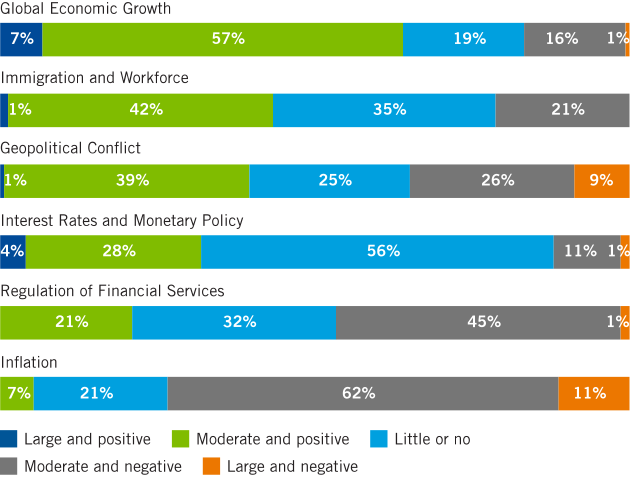
This “risk-on” mode also fits with question 4. “How do you expect shocks to impact your portfolio?”
How Will You Alter Your Equity Holdings over the next Six Months?
Look at how small the “large and negatives” percentages are. And if you combine the two negative categories, only “regulation” and “inflation” are real fears.
Caramazza: You would have to call this looking through “rose-colored glasses.” Respondents are basically saying their portfolios are well-positioned for shocks. Or perhaps it is a behavioral phenomenon? Are institutional investors saying, “I can only think of positive shocks?”
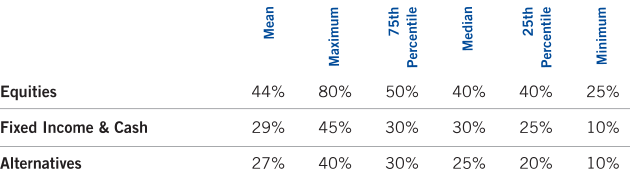
Fisher: In questions 1 and 2, we collected the portfolio allocations to equity, fixed income and alternatives. It surprised us how tight the bands were around the mean—really within plus/minus 10% on either side of the mean. We saw this no matter how we sliced and diced the data, and in some cases closer to plus/minus 5% of the mean.
How Is Each of the below Scenarios Likely to Affect Your Portfolio over the next 18 Months?
This held true as well for the allocation within equities. This is particularly surprising considering the wide selection of people participating in the survey and their different outcome needs. It causes us to zero in on “alternatives”—27%. That must be where the difference comes. Some may be thinking real estate, while others have unconstrained strategies, while others may have their liability hedge. Next survey we will see if we can tease that out.
Caramazza: The equity drilldown is also intriguing. I think we expected to see more home country-bias. Additionally, the percentage of emerging market allocation is high compared to capitalization-weighted expectations. I’d like to take a closer look at both topics in the next survey.
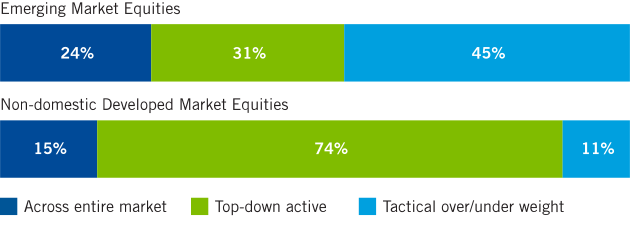
Perhaps one of the most interesting insights I got was from question 3, where we explore, “how do you invest in emerging markets and international markets?”
Please Estimate the Proportion of Your Organization's Allocations in Each of the Following Asset Classes
The overwhelming percentages for top-down and tactical weighting suggest some level of active management—whether in the selection of the countries to index or in the selection of managers to invest across countries.
Fisher: This tilt toward active is not what we hear about in the press, nor necessarily see in the industry-wide flows. But, perhaps what we should be expecting from the readers of institutional investment publications. We do carry the mantra—invest country-by-country.
Caramazza: So, in summary, of the potential major global shocks to their portfolios, investors are most concerned about inflation. It has largely been dismissed for several years now, but this would suggest anxiety that it might occur is beginning to creep upward.
Fisher: Where are the TIPS searches? I am joking. Concern about inflation is such a curious finding. In the field, it is just not a subject that seems to be top-of-mind with large institutional investors and gatekeepers. And, yet, we know from past experience that investors will claim to be shocked—shocked, I say—when inflation suddenly appears.
Caramazza: It is perhaps more revealing that institutional investors seem less nervous and more optimistic about the potential global shocks that dominate news headlines around the world—slowing economic growth, multiple geopolitical tensions, immigration and workforce issues.
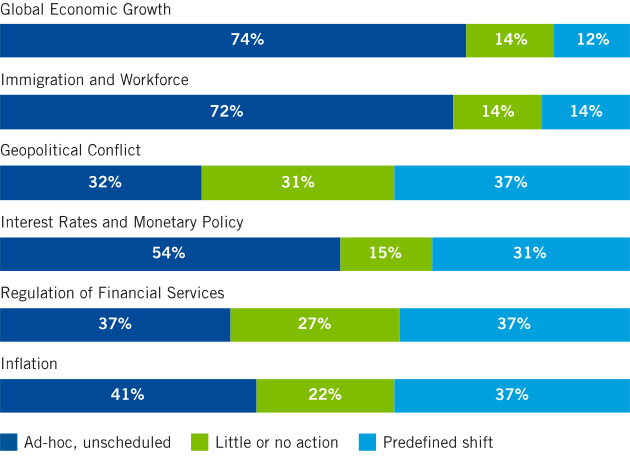
Fisher: For the most part, some degree of non-reactionary mindset is to be expected of institutional investment professionals who generally strategize and act long-term. However, investors’ calm before a potential storm seems at odds with their expressed preference—and I’m looking at the responses to question 5, now—to react in an ad hoc way to most global shock scenarios. In other words, they might only be literally shocked into action.
Do You Usually Invest Across the Entire Market, Take a Top-down Position at the Country Level, or Tactically Overweight/Underweight Specific Countries/Regions?
Do You Usually Invest Across the Entire Market, Take a Top-down Position at the Country Level, or Tactically Overweight/Underweight Specific Countries/Regions?
Caramazza: It made me wonder if institutional investors are more focused on fundamentals than they are on headlines.
Fisher: That’s the good news. That said, those of us who have been around the block once or twice, know bull markets eventually end, and growth will slow. It often happens over time, but it can also happen quickly—like we saw during the global financial crisis.
Caramazza: That wasn’t so long ago. Another reason I was surprised more managers were taking ad hoc approaches to shocks to growth rather than mapping out a predefined plan.
Fisher: It came to the top of my mind when we saw how many institutional investors were planning on increasing equity exposure, had almost no negative feelings about global growth, and would take an ad hoc approach to a shock to global growth.
Caramazza: This is where we need to dig deeper into alternatives. Could be they are hedged or diversified with assets not strongly tied to growth.
Fisher: Alternatives must be critical to understanding their differences—the good news is that there seems to be plenty going on with equities and adding risk there.
Caramazza: So, our three big takeaways are: First, that equities seem to be an active place for adding risk. Second, that the respondents all seem to have relatively similar allocations; so, to understand their differences we should ask more questions about how they define alternatives.
Fisher: And third, what people may be indicating about shocks—growth positive and inflation negative—does not necessarily fit with what we think we see in practice.
How Would Your Investment Team Respond to a Material and Unexpected Shock in the Following Scenarios?
About This Research
In May 2019, Institutional Investor’s Custom Research Lab and Franklin Templeton surveyed 150 investment decision makers—CIOs, investment officers, portfolio managers, directors of research, and research analysts—at institutions in North America. More than half the respondents represent an institution with at least US$5 billion in assets under management (AUM). However, when responses were broken down by level of AUM, there were no outlier groups—essentially, responses were consistent regardless of AUM.
Franklin Templeton and Institutional Investor will be partnering to periodically survey institutional asset owners to extend the dialogue about “What if….”. Participate in the next survey by emailing us today at [email protected]
-
Source: The Institutional Investor’s Custom Research Lab and Franklin Templeton Survey was conducted in May 2019. See “About this research” for more details. All data and charts referenced herein were derived from the aforementioned survey conducted
IMPORTANT LEGAL INFORMATION
This material is provided for informational purposes only and nothing herein constitutes investment, legal, accounting or tax advice. This material is general in nature and is not directed to any category of investors and should not be regarded as individualized, a recommendation, investment advice or a suggestion to engage in or refrain from any investment-related course of action. All information is current as of the date of this material and is subject to change without notice. Any views or opinions expressed may not reflect those of the firm or the firm as a whole. Franklin Templeton does not accept any responsibility to update any opinions or other information contained in this document. This material may include estimates, outlooks, projections and other “forward-looking statements.” Due to a variety of factors, actual events may differ significantly from those presented.
CFA® and Chartered Financial Analyst® are trademarks owned by CFA Institute.