

CONTRIBUTORS

Chris Clark
Chief Executive Officer, Co-Chief Investment Officer & President, RFS

Francis Gannon
Co-Chief Investment Officer, Managing Director, Royce Investment Partners
A quick look back
The last several years have not been especially kind to small-cap stocks, at least in relation to their bigger counterparts. The asset class’s long-running historical performance advantage over large-caps—an advantage that often went hand in hand with higher volatility—has steadily eroded. In what, for the purposes of this letter, we’ll call the “Old Normal,” small-cap companies generally had higher long-term returns but also experienced higher volatility, while larger companies trailed but tended to be steadier in their performance patterns. Since the introduction of the Russell Indexes on 12/31/78, a similar pattern often held true for value and growth investing: the former typically enjoyed a better long-term performance record while the latter had higher volatility but also often had attractively high short-term performance.
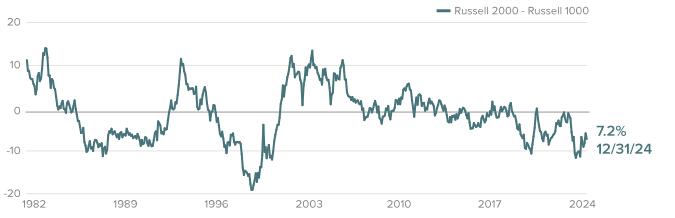
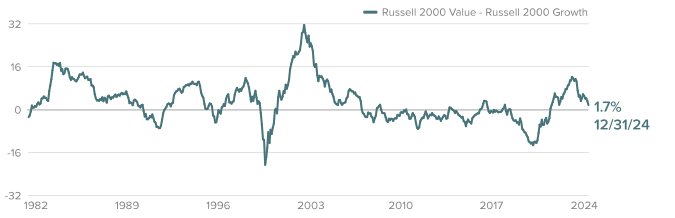
There were exceptions to these patterns, of course, and the persistence of leadership could span several years. For example, small-cap, and small-cap value in particular, dominated performance from the peak of the Internet bubble in March of 2000 up until the market peaks in the summer of 2007 that presaged the Great Financial Crisis of 2008-09. In retrospect, any path out of that seismic series of events and back to what history might see as normal, or at least typical, was bound to be winding and uncertain. There were also additional and unprecedented obstacles, the biggest by far being the covid pandemic, which saw policymakers once again slashing rates and keeping the flow of cash into the economy steady and strong. The current period of large-cap leadership, dominated by mega-cap stocks within the big stock cohort, stretches back to 2011, when a steep and sudden bear market lasted from April through October on fears that the economy was falling into a recession. This 14-year span has also been better for small-cap growth than value. The two charts below show the spreads for the 3-year monthly rolling average returns, first for the Russell 2000 and Russell 1000 Indexes and second for the Russell 2000 Value and Growth Indexes from their shared inception dates through 12/31/24.
Leadership Shifts Between Small-Cap and Large-Cap
The Spread of 3-Year Monthly Rolling Average Annual Total Returns for the Russell 2000 and Russell 1000, 12/31/81-12/31/24
Source: Russell Investments. Past performance is no guarantee of future results.
Leadership Shifts Between Small-Cap Value and Growth
The Spread of 3-Year Monthly Rolling Average Annual Total Returns for the Russell 2000 Value and Russell 2000 Growth, 12/31/81-12/31/24
Source: Russell Investments. Past performance is no guarantee of future results.
2024 thus marked the eighth straight year of small-cap underperformance relative to large-cap. In fact, the Russell 2000 has beaten the Russell 1000 in only four of the last 20 calendar years, during which large-cap’s average outperformance spread was 6.1%. Small-cap last beat large-cap in 2016, making the period ended 12/31/24 the longest underperformance stretch measured by calendar years since each index’s inception. And while we are all to keenly aware of how long we have been calling for a sustained period of small-cap leadership, we do see several promising signs on the horizon for a sustained leadership phase for small-cap stocks.
Do valuations favor the odds of US small-cap leadership?
Much ink has been spilled and even more bandwidth has been spent discussing, worrying about, or otherwise focusing on the sky-high state of valuations in the US equity market over the last 12-18 months. We would offer what follows as a corrective to what looks to us like a narrow viewpoint on share prices. Most of these observations have used the S&P 500 as the proxy for the entire market, occasionally adding the Nasdaq Composite or Nasdaq 100. We have no disagreement with the idea that large-cap valuations are unsustainably high. However, small-cap valuations remain attractive versus large-cap valuations, having finished 2024 still near their lowest relative valuation versus large-caps in more than 25 years, based on the index valuation metric we use most: the last 12 months’ enterprise value over earnings before interest & taxes, aka LTM EV/EBIT. The chart below shows this picture in compelling detail—while also revealing that this wide valuation spread has persisted for more than five years.
Relative Valuations for Small-Caps vs. Large-Caps Are Near Their Lowest in 25 Years
Russell 2000 vs. Russell 1000 Median LTM EV/EBIT* (ex. Negative EBIT Companies), 12/31/99-12/31/24

Source: FactSet *Enterprise Value/Earnings Before Interest and Taxes.
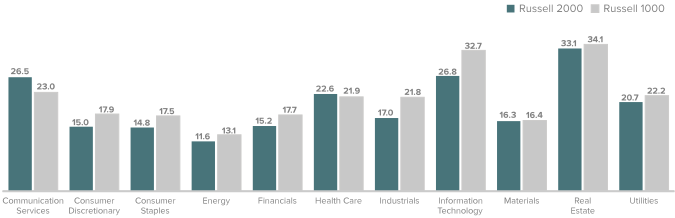
With small-cap’s underperformance versus large cap having reached an extreme point, it should come as no surprise that small-cap’s weighting in the Russell 3000 Index was also near a historical low at the end of 2024. Equally, if not more important is the fact that small-cap’s more attractive valuation could be seen across all 11 sectors. These disparities in sector valuations between small- and large-cap are notable, especially in the broad and diverse areas such as information technology, industrials, financials, and consumer discretionary. They add further credence to the idea that, while mega-cap behemoths such as Nvidia or Apple may be priced beyond perfection (or at least reason), attractive bargains can be found in several corners of the small-cap universe. (In fact, Apple’s market cap at the end of 2024 was 122% of the entire Russell 2000.)
Wide Breadth of Undervaluation Across the Small-Cap Asset Class
Russell 2000 and Russell 1000 Median EV/EBIT* (ex. Negative EBIT) by Sector as of 12/31/24
Source: FactSet *Enterprise Value/Earnings Before Interest and Taxes.
However, the most important factor about valuations from our perspective as small-cap specialists is that many companies in the asset class continue to trade at attractively cheap prices on an absolute basis in diverse areas such as machinery; semiconductors & semiconductor equipment; capital markets; electronic equipment, instruments & components; banks; construction & engineering; healthcare; and energy.
Earning their way to market leadership
While attractive absolute and relative valuations for small-caps are noteworthy, valuation is seldom enough to catalyze stock price performance. We are fond of saying that psychology runs the market in the short run, but earnings run it in the long run. Across the US equity markets, earnings are expected to be pretty healthy in 2025, with the current consensus indicating 15% earnings per share (EPS) growth for the Russell 1000, along with solid to strong results anticipated for 4Q24, which are in the midst of being reported and will pick up steam within small-caps as we move further into February. Consensus EPS estimates for the Russell 2000, however, are considerably higher than they are for large-caps in 2025, coming in at an impressive 89.3% versus 30.9% for the Russell 1000.
Average Expected Earnings Growth for 2025-2026
Index Aggregate Estimated Two-Year EPS Growth
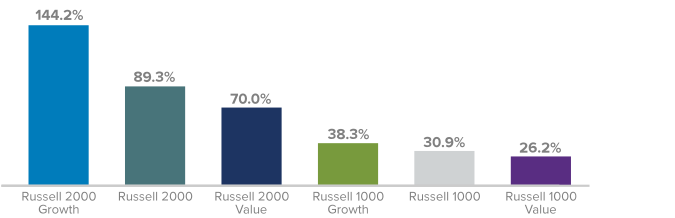
Source: FactSet. Earnings per share (EPS) is calculated as a company’s profit divided by the outstanding shares of its common stock. The EPS Growth Estimates are the pre-calculated mean two-year EPS growth rate estimates by brokerage analysts. Estimates are the average of those provided by analysts working for brokerage firms who provide research coverage on each individual security as reported by FactSet. All non-equity securities, investment companies, and companies without brokerage analyst coverage are excluded.
There is some important context to accompany this encouraging data: the Russell 2000 finished 2024 having endured a two-year earnings recession, so a substantive rebound makes a certain amount of sense. It’s also important to keep in mind that more than 40% of the companies in the Russell 2000 currently have no earnings. We think it’s equally relevant to remind our readers that our own portfolios typically hold companies that have established histories of earnings or those where our respective investment teams have identified a catalyst for earnings to resume or begin.
What follows low-return US small-cap markets?
At 12/31/24, the Russell 2000’s 3-year average annual total return was 1.2%, well below the small-cap index’s monthly rolling average 3-year return of 10.5% since inception. This highly underwhelming number perhaps distills the frustrations of small-cap investors better than any other. Yet it may also be a sign that improved results may be close. Subsequent 3-year average annualized performance for small-caps following previous low-return periods have been stellar, as seen in the chart below.
99% of the Time, Positive 3-Year Returns Have Followed Low Return Markets
Subsequent Average Annualized 3-Year Performance for the Russell 2000 Following 3-Year Annualized Return Ranges of Less Than 3%, 12/31/81-12/31/24
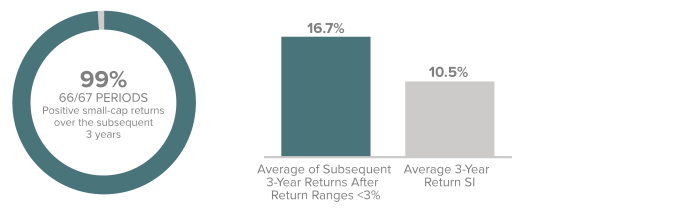
Source: Russell Investments. Past performance is no guarantee of future results.
Russell 2000 vs Russell 1000 Monthly Rolling VIX Regimes
Subsequent Average 1-Year Return Periods After VIX 1-Month Average was ≥ 28% from 12/31/89 through 12/31/24
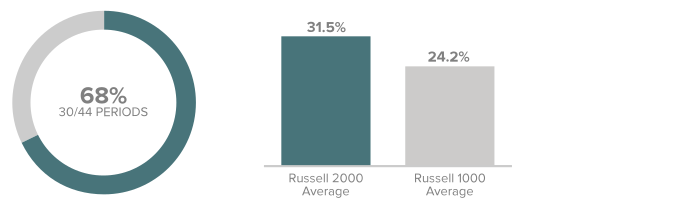
Source: Bloomberg. VIX was ≥28% in 44/408 periods. Past performance is no guarantee of future results. The chart above measures the average returns and spread of the monthly trailing three-year return periods in month where the monthly average three-year VIX level falls within the specified range.
Interestingly, recent uncertainty—and the now familiar idea that the new administration’s policies seem likely to create ample doses of (ideally short-lived) market gyrations—has not yet translated to a higher-than-average VIX, which was lower than average between election day through February 7. What has been on the rise, according to an article in the February 10th issue of Barron’s,1 is the VVIX—which measures the volatility of the VIX and can be seen as a "fear of fear" index. The VVIX has risen past its historical average of 92.86 to 99.04 over the same post-election day period. This is hardly the worst development for a highly active small-cap investors with a long-term investment horizon like us. We welcome a market environment that, at least in the short run, distracts investors from longer-term business fundamentals and economic value, which is often the case when markets experience elevated volatility. These distractions often appear to blur the distinctions between companies that possess higher quality attributes versus those that do not. As we move further into 2025, we remain highly constructive on the backdrop for small-cap stocks and for our differentiated and highly active approach to constructing our portfolios.
EndNotes
Source: Barron’s, “Trump 2.0 Is Shock and Awe. What Wall Street Will Stand For,” February 7, 2025.
Definitions
The Russell 1000 Index is an unmanaged, capitalization-weighted index of domestic large-cap stocks. It measures the performance of the 1,000 largest publicly traded US companies in the Russell 3000 Index.
The Russell 1000 Growth Index is an unmanaged index of those companies in the large-cap Russell 1000 Index chosen for their growth orientation.
The Russell 1000 Value Index is an unmanaged index of those companies in the large-cap Russell 1000 Index chosen for their value orientation.
The Russell 2000 Index is an index of domestic small-cap stocks that measures the performance of the 2,000 smallest publicly traded US companies in the Russell 3000 Index.
The Russell 2000 Growth Index is an unmanaged index of those companies in the small-cap Russell 2000 Index chosen for their growth orientation.
The Russell 2000 Value Index is an unmanaged index of those companies in the small-cap Russell 2000 Index chosen for their value orientation.
The Russell 3000 Index is an unmanaged index of the 3,000 largest US companies.
The Standard & Poor’s® 500 Index (S&P 500®) is a market capitalization-weighted index of 500 stocks designed to measure total US equity market performance.
The Nasdaq Composite Index is a market capitalization-weighted index of more than 3,700 stocks listed on the Nasdaq stock exchange.
VIX is the ticker symbol and the popular name for the Chicago Board Options Exchange's CBOE Volatility Index, a popular measure of the stock market's expectation of volatility based on S&P 500 index options.
WHAT ARE THE RISKS?
All investments involve risks, including possible loss of principal. Past performance is no guarantee of future results. Please note that an investor cannot invest directly in an index. Unmanaged index returns do not reflect any fees, expenses or sales charges.
Equity securities are subject to price fluctuation and possible loss of principal.
Commodities and currencies contain heightened risk that include market, political, regulatory, and natural conditions and may not be suitable for all investors.
Small- and mid-cap stocks involve greater risks and volatility than large-cap stocks.
US Treasuries are direct debt obligations issued and backed by the “full faith and credit” of the US government. The US government guarantees the principal and interest payments on US Treasuries when the securities are held to maturity. Unlike US Treasuries, debt securities issued by the federal agencies and instrumentalities and related investments may or may not be backed by the full faith and credit of the US government. Even when the US government guarantees principal and interest payments on securities, this guarantee does not apply to losses resulting from declines in the market value of these securities.
Company referenced for illustrative purposes only. Discussions should not be regarded as any type of trading recommendation, or as a signal about any past, current or future trading activity in any fund or strategy, by Royce Investment Partners or Franklin Templeton. Past performance does not guarantee future results.
Any data and figures quoted in this article sourced from Russell Investments, FactSet, Bloomberg and Reuters.
Important data provider notices and terms available at www.franklintempletondatasources.com. All data is subject to change.