

CONTRIBUTORS

Frank Gannon
Chief Investment Officer
Royce Investment Partners
Time will tell, of course, but we are highly encouraged by what history and the current economic and market environment suggest about the potential for small-cap to hang on to market leadership.”
With less than a month to go, 3Q24 is already shaping up to be this year’s most eventful quarter. First, July gave investors a significant divergence in results in favor of small-cap, with the Russell 2000 Index rising 10.2% while the large-cap Russell 1000 Index gained 1.5%. That same month also saw the Russell 2000 Value Index (+12.2%) outpace the Russell 2000 Growth Index (+8.2%). The disparity in July’s returns was extreme at the extremes of market capitalization: the Russell Microcap Index advanced 11.9% while the mega-cap Russell Top 50 Index fell -0.4%.
Yet before we could breathe a sigh of relief or take a victory lap to celebrate small-cap’s long awaited, though nascent market leadership, August began with a bearish wave as the globe’s largest “carry trade” unwound when a resurgent Japanese yen led speculators to shut down bets totaling hundreds of billions of dollars across the globe. Share prices then stabilized somewhat as August went on, with small-caps down -1.5% and large-caps up 2.4%, only to fall precipitously the day after Labor Day. Amid all this volatility, we noted that the equal-weighted Russell 1000 reached a new high in August. And while we don’t usually discuss the large-cap index beyond its performance, we have looked at historical data and found that when the equal-weighted Russell 1000 outperformed the capitalization-weighted Russell 1000, small-caps generally led. This makes sense to us because small-caps have generally performed at a market-leading level well when positive performance is more evenly distributed throughout the market. So, we see greater breadth in market returns as a positive sign for small-cap’s relative performance prospects.
We are also anticipating that the Fed will lower interest rates later this month, though we are agnostic about the size of the reduction—or its long-term effect on stock prices. However, because many observers have pinned the prospects for a sustained period of small-cap leadership to lower rates, we examined what small-caps have done following previous rate cuts. Our study took us back to November of 1957 (Fed Funds rate data goes back to July of 1954, with the first cut in 1957). As we always do when looking farther back than the 12/31/78 inception date for the Russell 2000 and Russell 1000, we used the Center for Research in Security Prices 6-10 (“CRSP 6-10 Index”) and CRSP 1-5 Index as our respective proxies for small- and large-cap stocks. The chart below shows that small-caps beat large-caps in the 3-, 6-, and 12-month periods following Fed rate reductions—and averaged double-digit returns in each period.
Small-Caps Performed Well Following Previous Fed Rate Cuts
CRSP 6-10 and 1-5 Performance After Initial Fed Rate Cuts, 11/1/57-7/31/24
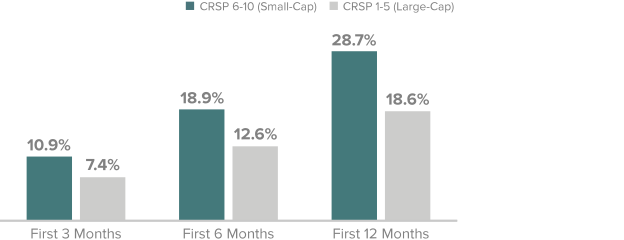
Source: Center for Research in Security Prices (CRSP). Indexes are unmanaged and one cannot directly invest in them. They do not include fees, expenses or sales charges. Past performance is not an indicator or a guarantee of future results.
We think that this history is important to balance versus the current context of the rate reduction—which in all likelihood will be made against the backdrop of a healthy U.S. economy—and certainly a non-recessionary one. In other words, the Fed is not seeking to jump start a moribund economy with a rate cut.
We think another context is equally important. July’s 10%-plus return for the Russell 2000 is rare. The small-cap index has seen only 22 months with a double-digit return since its 12/31/78 inception. As was the case following rate cuts, the average subsequent 3-, 6-, and 12-month returns for small-caps following a 10% or higher monthly performance were impressive—and well above the Russell 2000’s monthly rolling averages, as can be seen in the chart below.
Double-Digit Monthly Returns Led to Strong Subsequent Small-Cap Returns
The Russell 2000’s Average Monthly Returns After 10%-Plus Months versus Monthly Rolling Returns Since Inception (12/31/79)
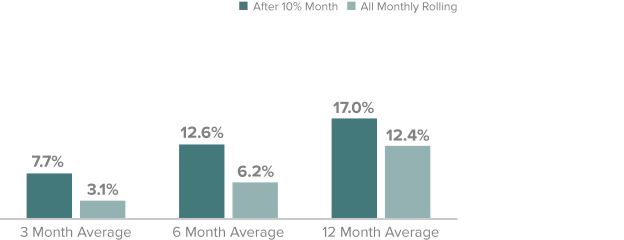
Source: Russell Investments. Indexes are unmanaged and one cannot directly invest in them. They do not include fees, expenses or sales charges. Past performance is not an indicator or a guarantee of future results.
Time will tell, of course, but we are highly encouraged by what history and the current economic and market environment suggest about the potential for small-cap to hang on to market leadership.
Stay tuned…
Definitions
The Russell 1000 Index is an unmanaged, capitalization-weighted index of domestic large-cap stocks. It measures the performance of the 1,000 largest publicly traded US companies in the Russell 3000 Index.
The Russell 2000 Index is an index of domestic small-cap stocks that measures the performance of the 2,000 smallest publicly traded US companies in the Russell 3000 Index.
The Russell 2000 Value and Growth indexes consist of the respective value and growth stocks within the Russell 2000 as determined by Russell Investments.
The Russell Microcap Index includes 1,000 of the smallest securities in the small-cap Russell 2000 Index, along with the next smallest eligible securities as determined by Russell.
The Russell Top 50 Index measures the performance of the largest companies in the Russell 3000 Index. It includes approximately 50 of the largest securities based on a combination of their market cap and current index membership and represents approximately 40% of the total market capitalization of the Russell 3000 Index.
The CRSP 6-10 Index represents the returns of the smaller half of the US equity market while the CRSP 1-5 Index represents the returns of the larger half of the equity market.
WHAT ARE THE RISKS?
All investments involve risks, including possible loss of principal. Past performance is no guarantee of future results. Please note that an investor cannot invest directly in an index. Unmanaged index returns do not reflect any fees, expenses or sales charges.
Equity securities are subject to price fluctuation and possible loss of principal.
Commodities and currencies contain heightened risk that include market, political, regulatory, and natural conditions and may not be suitable for all investors.
Small- and mid-cap stocks involve greater risks and volatility than large-cap stocks.
US Treasuries are direct debt obligations issued and backed by the “full faith and credit” of the US government. The US government guarantees the principal and interest payments on US Treasuries when the securities are held to maturity. Unlike US Treasuries, debt securities issued by the federal agencies and instrumentalities and related investments may or may not be backed by the full faith and credit of the US government. Even when the US government guarantees principal and interest payments on securities, this guarantee does not apply to losses resulting from declines in the market value of these securities.
Any companies and/or case studies referenced herein are used solely for illustrative purposes; any investment may or may not be currently held by any portfolio advised by Franklin Templeton. The information provided is not a recommendation or individual investment advice for any particular security, strategy, or investment product and is not an indication of the trading intent of any Franklin Templeton managed portfolio. Past performance does not guarantee future results.
Any data and figures quoted in this article sourced from Russell Investments, FactSet, Bloomberg and Reuters.
Important data provider notices and terms available at www.franklintempletondatasources.com. All data is subject to change.