

CONTRIBUTORS

Francis Gannon
Co-Chief Investment Officer, Managing Director
A positive quarter for small-cap stocks
As long-term small-cap investors, we learned long ago that a quarter is nearly always too short a span by which to judge the worth of investment or the direction of a performance cycle. We were once more reminded of the importance of this observation when reviewing the performance for the small-cap Russell 2000 Index versus its large-cap counterpart, the Russell 1000 Index for 1Q24.
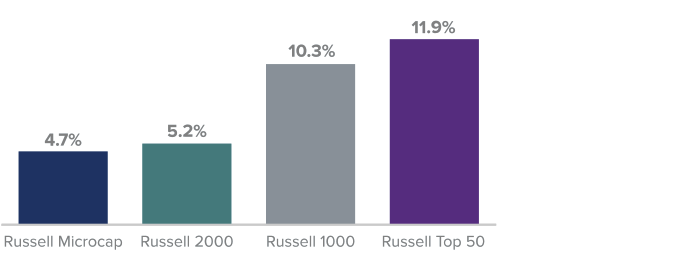
The small-cap index rose a more than respectable 5.2% in 2024’s opening quarter, trailing the Russell 1000, which gained 10.3%. The large-cap index continued to be dominated by mega-cap stocks, as evidenced by the 11.9% advance for the Russell Top 50 Index in 1Q24. Once more, returns skewed higher the further up the capitalization scale one went, with the Russell Microcap Index up 4.7% for the quarter.
Bigger Was Better in 1Q24
Russell Index Returns, 12/31/23-3/31/24
Source: Russell Investments. Past performance is no guarantee of future results.
Context matters
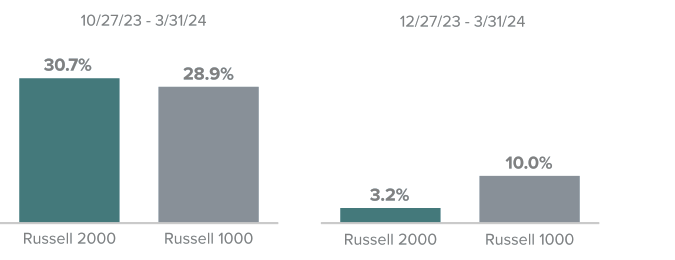
Yet in our view these quarterly results for the U.S. equity indexes do not tell the whole story. From the most recent small-cap low on 10/27/23, when large-cap indexes were also scuffling, the Russell 2000 advanced 30.7% and the Russell 1000 was up 28.9%. Moreover, from that low through 2023’s high on 12/27/23, the small-cap index rose 26.6% versus 17.2% for the Russell 1000. The Microcap Index was especially strong, rising 30.8% over this 60-day span, while the Russell Top 50 was up “only” 14.8%.
Context Is Key in Understanding Recent Performance
Returns for the Russell 2000 and Russell 1000 Indexes
Source: Russell Investments. Past performance is no guarantee of future results.
It seems clear to us, then, that the first quarter of 2024 was a consolidation period—a common occurrence after particularly sharp short-term rallies—when investors took gains and/or flew back to the—perceived in our estimation—safety of mega-cap stocks. From 12/28/23 through 3/31/24, the Russell 2000 had a 3.2% gain while the Russell Microcap was up 2.5%, the Russell 1000 rose 10.0%, and the Russell Top 50 was up 11.6%.
Small-cap value and growth vie for long-term leadership
A similar dynamic has played out within small-cap. The Russell 2000 Value Index (+26.8%) and Russell 2000 Growth Index (+26.4%) were virtually neck and neck from 10/27/23 through 12/27/23. This was somewhat surprising, and certainly encouraging, as small-cap value typically trails in short-term upswings, especially those with dramatic, double-digit gains. This role reversal then held sway into the first quarter, as the small-cap value index was up slightly, 2.9%, while small-cap growth rose 7.6%.
This same jockeying for pole position could be seen in longer-term annualized performance periods. The Russell 2000 Value was ahead for the 3-, and 5-year periods ended 3/31/24 while the Russell 2000 Growth led for the 1-, and 10-year periods.
Elsewhere in small-cap
Investing in high-quality small-cap companies—those with high returns on invested capital, discernible competitive advantages, and sustainable business franchises—is a cornerstone of our work. We were therefore interested to see recent results for the S&P SmallCap 600 Index, which, unlike its large-cap S&P 500 sibling, requires that companies meet “investability and financial viability criteria” for index inclusion. For example, prospective constituents must have positive as-reported earnings over the most recent quarter, as well as for the most recent four quarters summed together. This requirement makes the index something of a proxy for small-cap quality.
So, it was interesting to us that the S&P SmallCap 600 trailed off the October low, up 25.7% from 10/27/23 through 12/27/23, and from the December high through the end of March, up 0.9% from 12/27/23 through 3/31/24. These results are potentially important because in our experience profitable companies typically trail during the early stages of sustainable small-cap rebounds.
We also found it notable that small-caps outside the U.S. trailed their bigger cousins—and did so by a wider margin than we have seen over the last several quarters between the two asset classes. The MSCI ACWI ex-USA Small Index was up 2.1% in 1Q24 versus a 5.2% gain for the MSCI ACWI ex-USA Large-Cap Index. Needless to say, this wider-than-has-been usual spread bears watching through the remainder of 2024.
The small-cap sector story
Based on contributions to return, Information Technology and Industrials led the Russell 2000’s 11 equity sectors in 1Q24, followed by Energy. The biggest detractors were Financials—where banks dragged down results for the entire sector—Real Estate, and Utilities.
In spite of their usual sensitivity to falling interest rates, both Energy sector and Health Care were positive contributors in 1Q24. Perhaps most surprising in this context was the impressive strength from the construction & engineering group within Industrials—which was the fourth top-contributing industry in the Russell 2000 for 1Q24.
An optimistic outlook in three charts
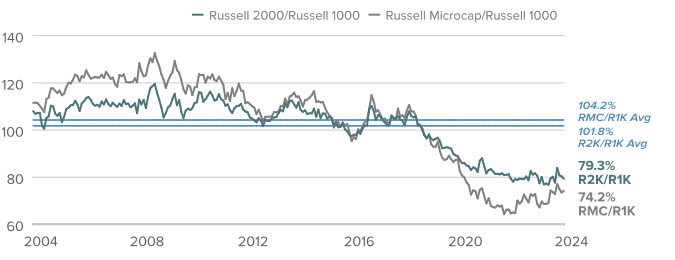
We believe that small-cap has important advantages over large-cap that set the asset class up for market leadership going forward. First, the Russell 2000 continues to have a substantially more attractive valuation than its large-cap counterpart at the end March based on our preferred index valuation metric of enterprise value to earnings before interest and taxes, or EV/EBIT.
Relative Valuations for Small- and Micro-Caps vs. Large Caps Are Near Their Lowest in 20 Years
Russell 2000 and Russell Microcap vs. Russell 1000 Median LTM EV/EBIT* (ex. Negative EBIT Companies), 3/31/04 through 3/31/24
*Last twelve months enterprise value/earnings before interest and taxes. Source: Russell Investments. Past performance is not an indicator or a guarantee of future performance.
Small-cap value also continued to sell at a below average valuation vis-à-vis small-cap growth at the end of the first quarter, as measured by EV/EBIT. Those micro-cap stocks with positive EBIT—roughly half the companies in the Russell Microcap Index at the end of March—also remained very attractively valued relative to large-cap based on EV/EBIT. (By comparison, 67% of the companies in the Russell 2000 had positive EBIT and more than 90% in the Russell 1000 had positive EBIT as of 3/31/24.)
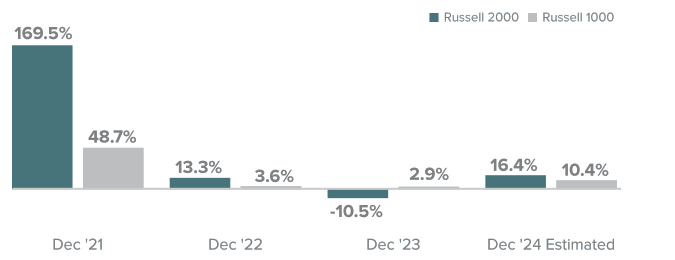
Second, we reiterate our contention that as the U.S. economy experiences ever more tangible benefits accrued from reshoring, the CHIPS Act, and several infrastructure projects, advantages will flow to many small-cap companies. Third, earnings growth for small-cap companies is expected to be higher than for larger-cap businesses through the rest of 2024.
Small-Cap’s Estimated Earnings Growth Is Expected to Be Higher in 2024 than Large-Cap’s
1-Year EPS Growth as of 3/31/24
Source: FactSet. Earnings per share (EPS) is calculated as a company’s profit divided by the outstanding shares of its common stock. The EPS Growth Estimates are the pre-calculated mean long-term EPS growth rate estimates by brokerage analysts. Long Term Growth (LTG) is the annual EPS growth that the company can sustain over the next 3 or 5 years. Both estimates are the average of those provided by analysts working for brokerage firms who provide research coverage on each individual security as reported by FactSet. All non-equity securities, investment companies, companies without brokerage analyst coverage are excluded. Past performance is no guarantee of future results.
Additionally, we tend to hold companies with little or no debt—a distinct advantage in our view in a world where the cost of capital matters again.
Finally, we understand the frustrations of investors who have experienced underwhelming small-cap returns, especially for the 3 years ended 3/31/24, when the Russell 2000 lost 0.1%. However, when the small-cap index had low or negative returns over annualized 3-year periods, subsequent 3-year annualized returns were positive 99% of the time, in 66 of 67 periods, and averaged an impressive 16.7%, beating the Russell 2000’s long-term average annualized 3-year return of 10.7%.
99% of the Time, Positive 3-Year Returns Have Followed Low Return Markets
Subsequent Average Annualized 3-Year Performance for the Russell 2000 Following 3-Year Annualized Return Ranges of Less Than 3%, 12/31/81-3/31/24

Source: Russell Investments. Past performance is no guarantee of future results. As of 3/31/24, the average of subsequent 3-year return ranges <3% had 67 periods, the average 3-year return since inception had 508 periods.
With valuations, earnings, and fundamentals all favoring select small-caps, we are decidedly optimistic about the prospects for active and risk-conscious small-cap management going forward.
Definitions
The Russell 1000 Index is an unmanaged, capitalization-weighted index of domestic large-cap stocks. It measures the performance of the 1,000 largest publicly traded US companies in the Russell 3000 Index.
The Russell 2000 Index is an index of domestic small-cap stocks that measures the performance of the 2,000 smallest publicly traded US companies in the Russell 3000 Index.
The Russell 2000 Value and Growth indexes consist of the respective value and growth stocks within the Russell 2000 as determined by Russell Investments.
The Russell Top 50 Mega Cap Index is a market-capitalization-weighted index of the 50 largest stocks in the broad-based Russell 3000 universe of US-based equities.
The Russell Microcap Index measures the performance of the microcap segment of the US equity market.
The MSCI ACWI ex USA Small-Cap Index is an unmanaged, capitalization weighted index of global small-cap stocks, excluding the United States.
The MSCI ACWI ex USA Large-Cap Index is an unmanaged, capitalization weighted index of global large-cap stocks, excluding the United States.
Enterprise value (EV) refers to the entire value of a company after taking into account both holders of debt and equity.
The EV/EBIT multiple is the ratio between enterprise value (EV) and earnings before interest and taxes (EBIT).
The CHIPS and Science Act (CHIPS Act) is a US federal statute enacted by the 117th United States Congress and signed into law by US President Joe Biden on August 9, 2022. The act provides roughly $280 billion in new funding to boost domestic research and manufacturing of semiconductors in the United States.
WHAT ARE THE RISKS?
All investments involve risks, including possible loss of principal. Past performance is no guarantee of future results. Please note that an investor cannot invest directly in an index. Unmanaged index returns do not reflect any fees, expenses or sales charges.
Equity securities are subject to price fluctuation and possible loss of principal.
Fixed-income securities involve interest rate, credit, inflation and reinvestment risks; and possible loss of principal. As interest rates rise, the value of fixed income securities falls.
International investments are subject to special risks including currency fluctuations, social, economic and political uncertainties, which could increase volatility. These risks are magnified in emerging markets.
Commodities and currencies contain heightened risk that include market, political, regulatory, and natural conditions and may not be suitable for all investors.
US Treasuries are direct debt obligations issued and backed by the “full faith and credit” of the US government. The US government guarantees the principal and interest payments on US Treasuries when the securities are held to maturity. Unlike US Treasuries, debt securities issued by the federal agencies and instrumentalities and related investments may or may not be backed by the full faith and credit of the US government. Even when the US government guarantees principal and interest payments on securities, this guarantee does not apply to losses resulting from declines in the market value of these securities.
Any companies and/or case studies referenced herein are used solely for illustrative purposes; any investment may or may not be currently held by any portfolio advised by Franklin Templeton. The information provided is not a recommendation or individual investment advice for any particular security, strategy, or investment product and is not an indication of the trading intent of any Franklin Templeton managed portfolio. Past performance does not guarantee future results.
Data and figures quoted in this article sourced from Russell Investments, Bloomberg and Reuters.